Customer Data Silos Inside A Five Person Company
Silos sound like a problem for big enterprises, but a five person company can hold more customer data in silos than a corporation, because every tool is another island. Payments sit in Stripe, orders in Shopify, invoices in Bokio or Fortnox, conversations in Missive, tasks in ClickUp, and nobody has a reason to join them until a question spans two tools. The silos did not appear by decision; they appeared one signup at a time. This post looks at how that happens, the hidden weekly tax they charge, and how to fix them without a migration.
How Silos Appear Without Anyone Deciding
Silos form the way most company problems form, gradually and by default. The team picks a tool for each job: Stripe for payments, Shopify for the store, Bokio for the books, Missive for the inbox, ClickUp for tasks. Each pick was a good decision alone, and none of them asked how the tools relate.
Each choice was sensible alone, and none of them required a decision about how the tools relate. The silos are simply the accumulation of good single tool choices, made at different moments by whoever needed them, which is why nobody recognizes a silo when it forms.
Silos harden with habit. Once the team is used to checking three tools for every customer question, that workflow becomes the normal way of working, and nobody questions it. The cost stops being noticed because it stops being compared, and familiarity becomes the silo's best defense.
The Hidden Weekly Tax They Charge
Silos charge a tax every week, and the tax is invisible because it is paid in small increments. Every customer question becomes a tour of the islands. Nobody bills the tour separately, so nobody sees the total, and the tax survives because it never appears on a report.
Five tool visits per question, a minute or two each, and the context assembled piece by piece in the head of the person answering. Multiply across the week's tickets and the tax is real hours, plus the mistakes that happen when a step is skipped.
The tax also includes the context that is simply lost. A refund decision made without the order record, a support reply written without the payment history, a follow-up that misses the task already assigned. None of those losses ever shows up in a report, yet each one changes the reply the customer gets.
Fixing Silos Without A Migration
The classic fix for silos is a migration: move everything into one system and leave the islands behind. For a five person company, that is usually the wrong answer, expensive, risky and built on the assumption that one tool can replace the others. The assumption is almost always wrong.
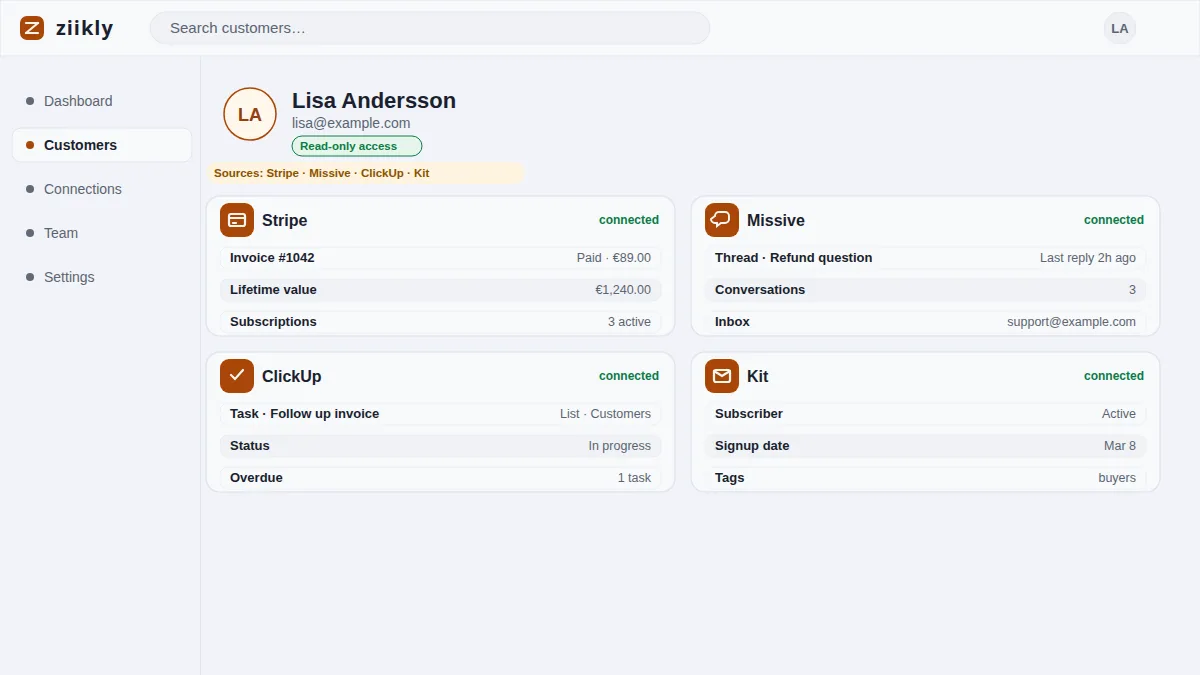
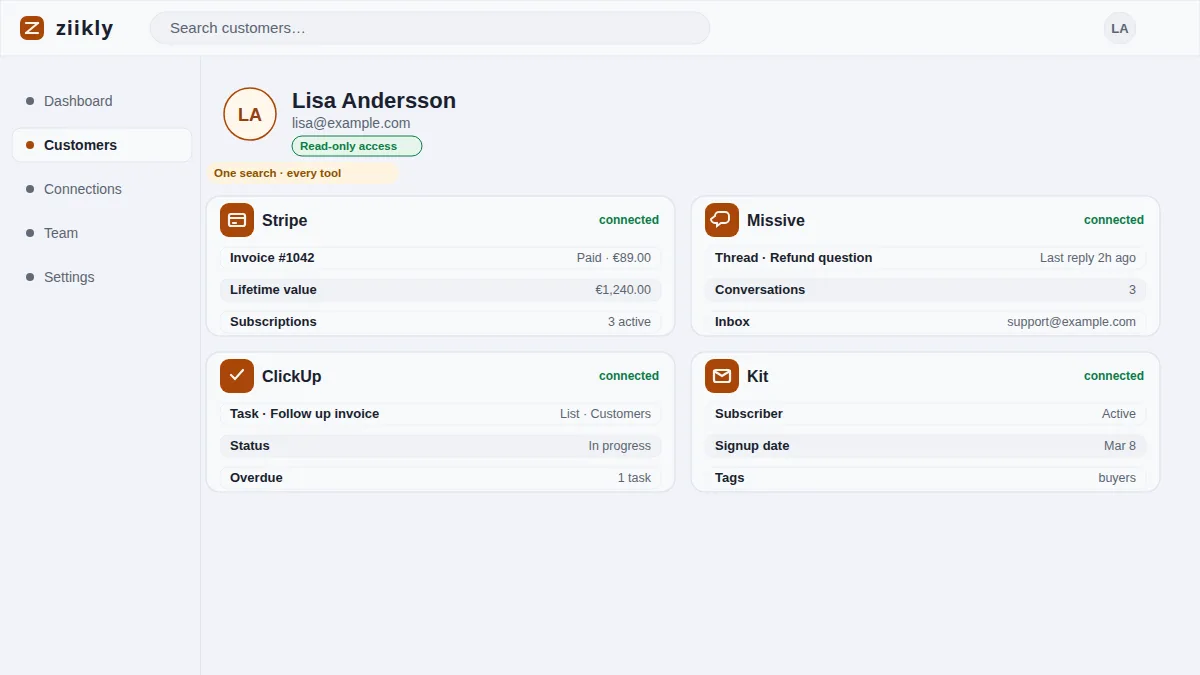
The cheaper fix is federation. Leave each tool exactly where it is and add a lookup that reads across them. Ziikly does this with read-only keys, so the store, the payments and the inbox stay put and a customer search returns their history from all of them at once.
No data moves, no workflows are rebuilt, and the silos remain as storage while they disappear as experience. The tools keep doing their jobs, and a lookup joins them only for the questions that cross the boundaries. That is the honest test of a fix: it removes the cost without removing what works.
Frequently asked questions
Do Silos Matter At This Size?
Yes, and they are more common at small size because few teams have tooling to join them. The cost shows up as lookup time, missed context and inconsistent answers. Silos matter exactly when a question spans more than one tool.
What is the cheapest way to break a silo?
Federation. Instead of migrating everything into one system, add a read-only lookup that queries each tool when you search a customer. No data moves, no workflows rebuild, and the customer history appears together while every tool keeps doing its own job.
See it on your own customers
Connect your tools with read-only keys and search a real customer in minutes. Ziikly is free for everyone right now.
Get started free