CDP Vs CRM Vs A Federated Customer View
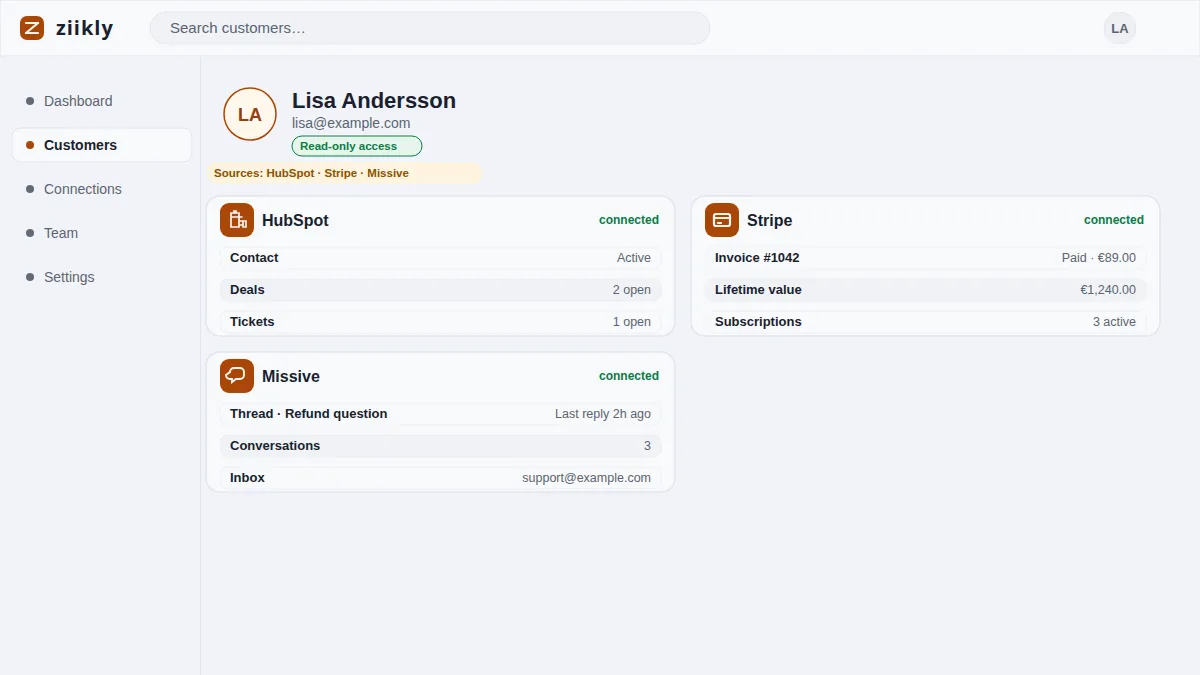
CDP, CRM and customer view are three terms that get used as if they mean the same thing, and they do not. A CRM manages the relationships and pipeline you record. A customer data platform collects and unifies customer data for marketing and analytics. A federated customer view answers the daily question "who is this customer?" by querying your existing tools live instead of storing a copy. The honest truth is that the categories overlap, vendors blur the lines, and the right choice depends on what your team actually does with customer data.
What Each Category Was Built To Do
Start with the purpose each category was designed for, because that is what each does best and where each should be judged. A tool is right when its designed job matches the job you actually need done. Everything else is feature creep dressed as advice.
A CRM was built to manage relationships: who you are selling to, where deals stand, what happened in each conversation. It is a working system for sales and account management, and its power is the structured record you maintain. The record is only as good as the daily discipline behind it.
A CDP was built to collect and unify customer data across sources, resolving identities into profiles for marketing, analytics and personalization. Its power is holding and activating the data it collects. That is why it is built for scale rather than for a handful of seats.
Setup Effort Compared Side By Side
Setup effort is where the categories differ most for a small team, because the effort decides whether the tool ever gets used. A system that takes a month to stand up is one the team will quietly abandon, and that failure is worse than never buying it.
A CRM asks for data entry and configuration from the start: fields, pipelines, and the habit of recording every interaction. It can be running in a day but useful only after the records have accumulated. The value follows the data, not the install, so the payoff is always delayed.
A CDP is a project. Sources, events, schemas, identity resolution and destinations all need planning, which is why CDP implementations are measured in weeks and months. It is a data engineering effort sold as a software purchase, and teams discover the scope after the contract.
Annual Cost At Small Team Size
The honest cost comparison at five to ten people is stark, and it is the reason the categories deserve a separate budget decision. Picking the category first, then the vendor, keeps the two decisions honest, and prevents the platform from deciding your architecture for you.
A CDP typically prices per monthly tracked user or through contracts sized to data volume, so the bill scales with your data. For a small team, the annual number often reaches five figures before you have used the platform, and it grows as your data grows.
A CRM prices per seat, so a team of five pays for five licenses forever. A federated customer view uses a flat plan, Ziikly at a single monthly price, regardless of how many customers you search. The cost stays predictable while the usage grows, which is the direction a small team actually wants.
Choosing Without Overbuying
Overbuying is the most common mistake in this category, and it usually happens when a team picks a platform based on what it could do rather than what the team will actually do this quarter. The brochure always wins the shortlist; the usage report tells the truth.
Write the customer data questions your team actually gets asked. If they are mostly "who is this and what happened with them", a federated view covers them and nothing is lost, because those are lookup questions, not platform questions. The list is the cheapest specification you will ever write.
If the questions are "which segment should this campaign target", that is CDP territory. If they are "what is the state of this deal", that is CRM territory. The scalable path is to buy the smallest thing that answers today's questions, and to upgrade only when the questions outgrow the answer.
Frequently asked questions
Can Five People Skip All Three?
Usually yes, if the daily need is customer context. A federated lookup across your existing tools answers most questions a five person team faces. Add a CRM when you need pipeline management, a CDP when you need marketing segmentation. And skip both until a real reason arrives.
What is the difference between a CDP and a federated customer view?
A CDP collects customer data into its own stored profiles and activates it for marketing and analytics. A federated view stores nothing and queries your tools live. The first enables segmentation; the second answers current customer questions. Different jobs, so they rarely compete directly.
See it on your own customers
Connect your tools with read-only keys and search a real customer in minutes. Ziikly is free for everyone right now.
Get started free